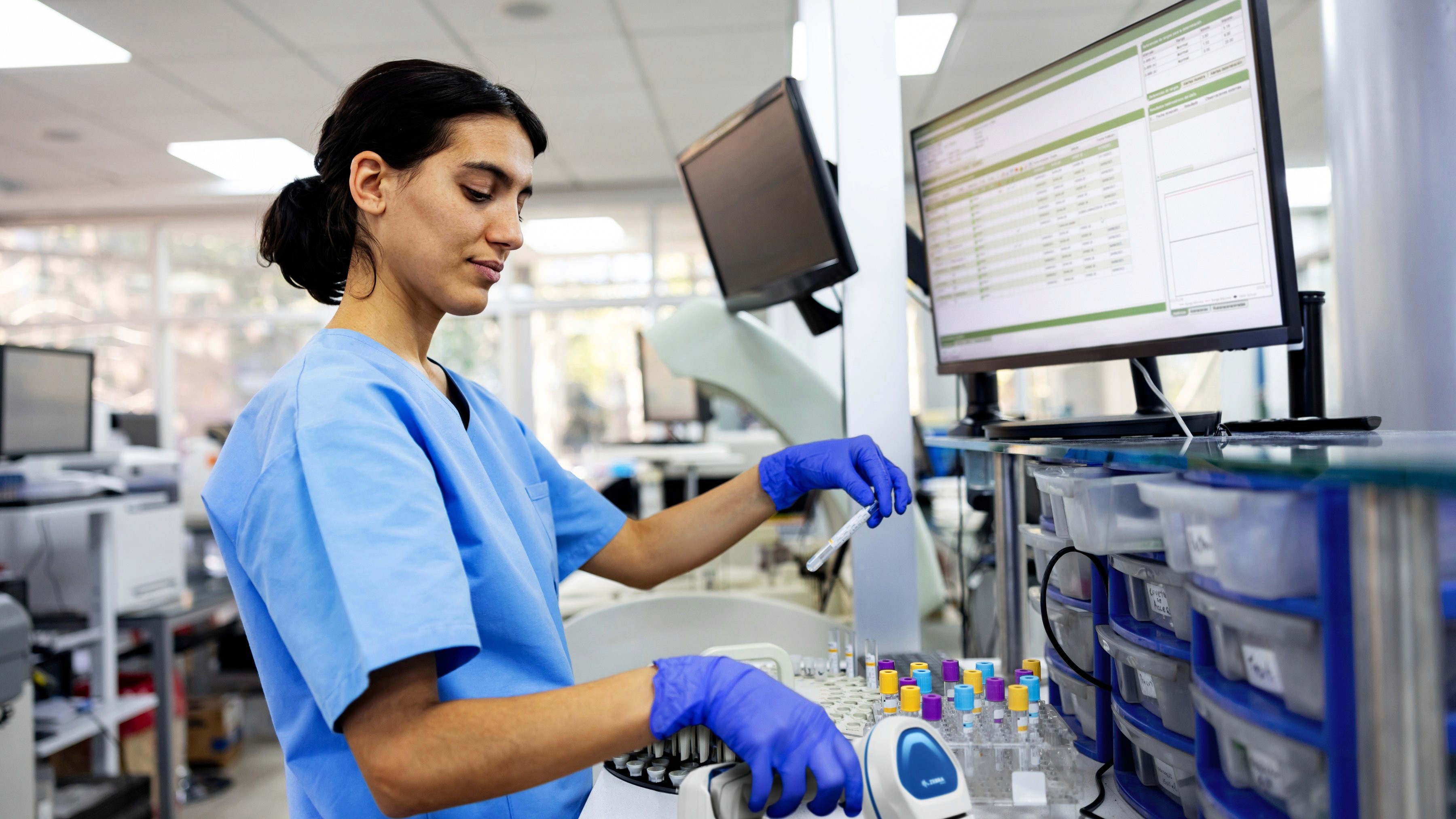
Past studies have shown some alarming statistics for the frequency of patient misidentification, specimen collection errors, and medication errors in healthcare.
In fact, 86% of clinicians have witnessed or known of a medical error due to patient misidentification. A concerning 1.3 million people are still harmed annually due to medication errors. And patient specimen labeling errors can occur with as many as 11.5% of all specimens collected.
Those are some startling numbers. But the good news is that these dangerous risks and errors can be greatly reduced or eliminated with a relatively simple improvement.
It starts with making sure that each patient is accurately and positively identified digitally on the spot and that each specimen and medication is scanned, matched, and verified—all at the patient’s bedside.
With clinical mobile technologies and cart-based solutions that make this easy and affordable to roll out across all patient identification, specimen collection, and medication management processes, there’s simply no excuse for not doing this. But amazingly, many hospitals are still not mobilizing, digitizing, and error-proofing these processes by bringing them right to the patient’s bedside.
Here are some key examples of how you can do better and start error-proofing your patient care, specimen collection, and medication management more effectively.
Some Key Examples of Bedside Error-Proofing Technologies and Processes
1. Bedside Patient Wristband Printing
At DCM, our healthcare technology and clinical mobility experts routinely work with hospitals and clinics to make sure that there is always a fast, simple, and reliable way to print, apply, and fasten patient ID wristbands to every patient at admissions or at the bedside.
With compact, cartridge-based wristband printers from Zebra, one of our key technology partners, a comfortable and highly durable patient ID wristband can be printed on demand from a mobile medical cart to match each patient and corresponding record in your EHR, laboratory or other systems. A nurse or other clinician can print and securely fasten the wristband in just seconds, and they can use a mobile device or barcode scanner to scan each wristband’s barcode and match it to the appropriate patient record.
2. Bedside Specimen Labeling
In many hospitals, the cart-based mobile printing approach is combined with bedside specimen collection and labeling. In this case, you can use a compact and easy-to-use Zebre healthcare printer to print specialized specimen labels right at the patient’s bedside. You can then scan and match them to each patient ID and to each lab order in your EHR or other system.
By enabling printing and labeling right at the bedside, there’s no risk of errors caused by having to walk back and forth between patient rooms and workstations. There’s also no issue with batch printing in advance, which introduces delays between printing labels and actually applying them accurately to the right collected specimens.
Instead, each individual specimen’s label is printed and applied on the spot, at the bedside, to minimize any risk of error. And specialized Zebra specimen labels are available with resistance to chemicals, fluids, deep freezing, and other conditions that can come into play with lab analysis.
So, any printed information and barcodes are protected and remain scannable and readable, even under extreme conditions or exposure. This is a perfect way to help ensure accuracy and minimize risks of specimen-labeling errors or damaged, unreadable labels that can disrupt lab processes and lead to dangerous patient care errors.
3. Bedside Medication and Patient Matching
Similarly, you can use bedside scanning, patient ID wristbands, and digital tracking to make sure that the right patient gets the right medication every time. Instead of manually consulting patient charts, medication labels, or managing batch medication distribution, you can scan each patient’s wristband, scan the corresponding medication bottle, and match them together and confirm correct dosage and administration procedures in your EHR.
It’s all possible with the same Zebra wristbands that you use for all other patient care management, plus a Zebra mobile computer to run a mobile version of your EHR and scan barcodes.
But mobile computing solutions aren’t your only option. Some hospitals create workstations on wheels that have a compact desktop PC and monitor paired with compact wristband and label printers and a Zebra healthcare barcode scanner—all on the same mobile cart. This lets nurses or other users access a full desktop version of your EHR, laboratory, medication management, or other systems, and they’re able to see patient data, charts and other information on a larger, digital screen and using a full keyboard.
Ultimately, the exact configuration and devices you use depends on your patient care needs and preferences as well as what works best for your workflows. But, in all cases, a complete system can be designed for mobile bedside identification, tracking, and error-proofed matching—all with Zebra printers, labels, and data capture devices purpose-built for healthcare needs.
Find the Right Solutions for Bedside Identification, Labeling and Tracking
To learn more about mobilizing, digitizing, and error-proofing your patient identification, specimen labeling, and medication matching at the patient’s bedside, contact us at DCM.
We’ll be happy to send you a complete guide to Zebra’s bedside printing, labeling, and tracking solutions and recommend the right options and configurations to meet your specific needs. We can also help you deploy and integrate these solutions in your patient care operations, so don’t hesitate to reach out to us for professional service, guidance and advice.
" width="71.00000093615597px"><path d="M 0 0 L 0 6.749 L 6.957 6.749 L 6.957 13.498 L 13.914 13.498 L 13.914 0 Z" fill="rgb(246, 206, 62)" height="13.498320000000021px" id="MO1aANKAT" transform="translate(57.086 0)" width="13.913773519163783px"/><path d="M 0 0.338 L 7.882 0.338 C 14.233 0.338 18.622 4.568 18.622 10.085 L 18.622 10.142 C 18.622 15.66 14.233 19.946 7.882 19.946 L 0 19.946 Z M 7.882 16.053 C 11.518 16.053 13.974 13.673 13.974 10.199 L 13.974 10.142 C 13.974 6.668 11.521 4.232 7.882 4.232 L 4.447 4.232 L 4.447 16.053 L 7.884 16.053 Z M 19.517 10.197 L 19.517 10.14 C 19.517 4.566 23.848 0 30.055 0 C 33.865 0 36.147 1.232 38.024 3.024 L 35.195 6.19 C 33.636 4.817 32.049 3.978 30.028 3.978 C 26.62 3.978 24.167 6.723 24.167 10.085 L 24.167 10.142 C 24.167 13.502 26.564 16.304 30.028 16.304 C 32.337 16.304 33.753 15.406 35.339 14.007 L 38.169 16.78 C 36.089 18.937 33.78 20.282 29.882 20.282 C 23.934 20.282 19.516 15.828 19.516 10.199 M 39.411 0.338 L 44.204 0.338 L 49.516 8.629 L 54.83 0.338 L 59.621 0.338 L 59.621 19.945 L 55.203 19.945 L 55.203 7.144 L 49.516 15.52 L 49.401 15.52 L 43.77 7.229 L 43.77 19.945 L 39.411 19.945 Z" fill="rgb(0, 0, 0)" height="20.281800098655914px" id="oz1K51fWz" transform="translate(0 10.697)" width="59.62132652649575px"/><path d="M 0 6.749 L 6.957 6.749 L 6.957 0 Z" fill="rgb(244, 140, 66)" height="6.7491600000000105px" id="uYm1ub0YW" transform="translate(64.043 0)" width="6.956886759581721px"/><path d="M 6.957 0 L 0 0 L 0 6.749 Z" fill="rgb(247, 167, 72)" height="6.7491600000000105px" id="LFZFxhWPD" transform="translate(64.043 0)" width="6.956886759581721px"/><path d="M 6.957 0 L 0 0 L 0 6.749 Z M 13.914 6.749 L 6.957 6.749 L 6.957 13.498 Z" fill="rgb(251, 192, 78)" height="13.498328872833202px" id="q7I33jitA" transform="translate(57.086 0)" width="13.913773051085627px"/><path d="M 0.588 0.325 L 0 0.325 L 0 0 L 1.544 0 L 1.544 0.325 L 0.956 0.325 L 0.956 1.851 L 0.59 1.851 L 0.59 0.325 Z M 1.951 0 L 2.342 0 L 2.919 0.878 L 3.495 0 L 3.873 0 L 3.873 1.851 L 3.52 1.851 L 3.52 0.535 L 2.932 1.419 L 2.895 1.419 L 2.307 0.535 L 2.307 1.851 L 1.954 1.851 L 1.954 0 Z" fill="rgb(0, 0, 0)" height="1.8512399342293122px" id="MYpBeS_sX" transform="translate(61.644 28.789)" width="3.8727159400534674px"/></g></g></svg>)